The wellbeing of over 20000 children in focus thanks to European Union support
23/01/2024
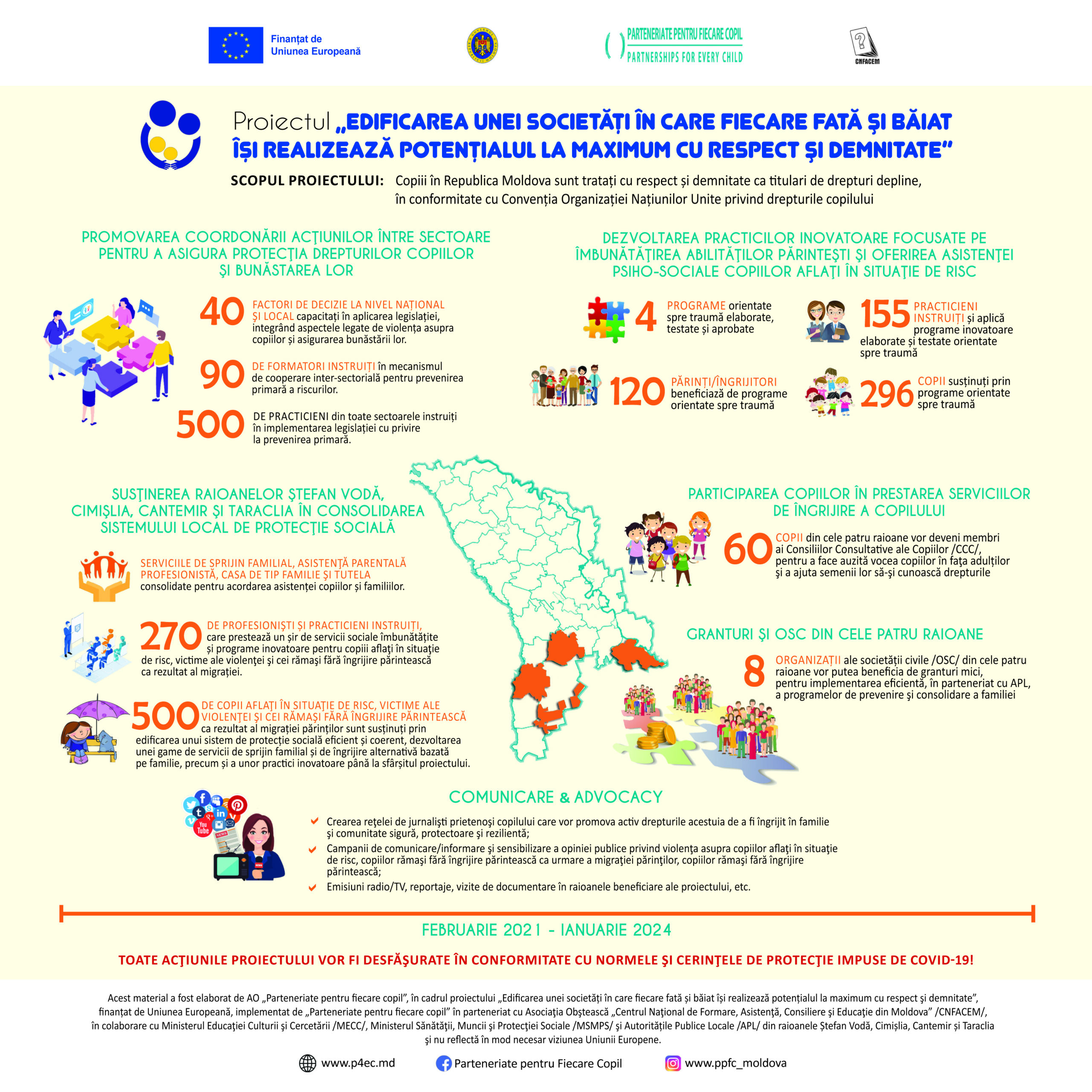
More than 20000 children have benefited from assistance and innovative programmes that helped improve their wellbeing, with a positive impact on their families and communities. The support was provided through the project “Building a society where every girl and boy can fully realise their potential with respect and dignity”, funded by the European Union. The project was implemented over a three-year period at national and local level, in the districts of Cantemir, Cimișlia, Taraclia and Ștefan Vodă.
The results of the project were presented on Tuesday, 23 January, during the final conference, attended by project partners and beneficiaries.
Eduard Pesendorfer, Programme Manager for Justice and Human Rights at the EU Delegation to the Republic of Moldova, stated during the closing conference that the European Union has increased its support to the Republic of Moldova across all sectors in the context of the complex crises of recent years and the EU accession process, including in the field of children’s rights protection. He highlighted the importance of each programme and activity implemented by P4EC and CNFACEM, carried out in close cooperation with national and local partners, noting that the direct involvement of children at local level in decisions affecting them is particularly valuable. The perspectives outlined by all actors following project implementation and lessons learned require continued joint efforts across all sectors to ensure children’s wellbeing in Moldova.
Valentina Olaru, State Secretary at the Ministry of Education and Research, underlined that ensuring children’s wellbeing and rights is a goal of the entire society and is also reflected in education policies. She noted that the results of this project demonstrate what can be achieved through joint efforts, and particularly welcomed the existence of a child wellbeing monitoring tool within the education system. While time is needed for its effective application, its added value will be felt, especially in terms of education quality, because when children feel safe, well and happy, teachers and parents also benefit.
According to Anastasia Gruzin, Deputy Head of the Directorate for Child Rights and Families with Children Policies at the Ministry of Labour and Social Protection, a key priority in current child protection policy is the development of early, community-level interventions to prevent risks. At the same time, sufficient resources are needed to provide timely support to children in communities, schools and families. The programmes developed within this project successfully addressed these objectives.
Daniela Mămăligă, Director of Partnerships for Every Child (P4EC), thanked the EU Delegation in the Republic of Moldova for financing the initiative and for keeping the issues of children and families high on the agenda. She emphasised that the project results demonstrate the value and necessity of continued investment in child protection, so that every girl and boy in the country truly has the opportunity to reach their full potential with respect and dignity. In the context of EU accession, this objective must remain a priority for all development partners.
As a result of project implementation, an improvement in the wellbeing of 17,629 children from schools and kindergartens across the country was recorded:
- 6,452 children received support in schools through the application of the intersectoral cooperation mechanism.
- 625 children facing wellbeing-related challenges were referred to social assistance or other relevant services for support.
At the same time:
- 60 trainers from 35 psycho-pedagogical assistance services nationwide were trained in applying the Intersectoral Cooperation Mechanism for primary prevention of risks and ensuring child wellbeing (Government Decision No. 143).
- 2,492 teachers were trained in the application of Government Decision No. 143.
- 557 schools applied primary prevention working tools.
At local level, in the districts of Cantemir, Cimișlia, Taraclia and Ștefan Vodă:
- 620 children at risk, victims of violence and children left without parental care due to migration were supported through social services.
- 665 children and 77 parents or caregivers benefited from psychosocial and educational programmes, including Mellow Parenting, PANDA, and the Educational Assistance and Counselling Programme for children at risk of developing violent behaviours and cognitions.
- 85 children were empowered as members of Advisory Board of Children to become promoters of children’s rights.
- 246 children from social services, including children with disabilities, children in professional parental care, children in family-type homes and children in placement centres, were monitored by members of the Advisory Board of Children.
- 358 decision-makers and professionals benefited from training activities aimed at strengthening the child protection system.
In addition:
- four civil society organisations from Cantemir, Cimișlia and Ștefan Vodă received small grants of approximately EUR 8,000 each to implement family strengthening and prevention programmes.
- 558 students, 141 parents and 37 teachers benefited from prevention and family strengthening programmes delivered by these organisations, which successfully responded to concerns and risks related to children’s wellbeing.