National Network of Trainers to Promote Trauma-Informed Child Protection
27/11/2026
A national network of trainers will help advance a new approach to child protection based on understanding the impact of trauma on children’s development and behaviour. The initiative aims to strengthen the capacity of professionals across the country to provide more effective, responsive support tailored to the needs of children and their families.
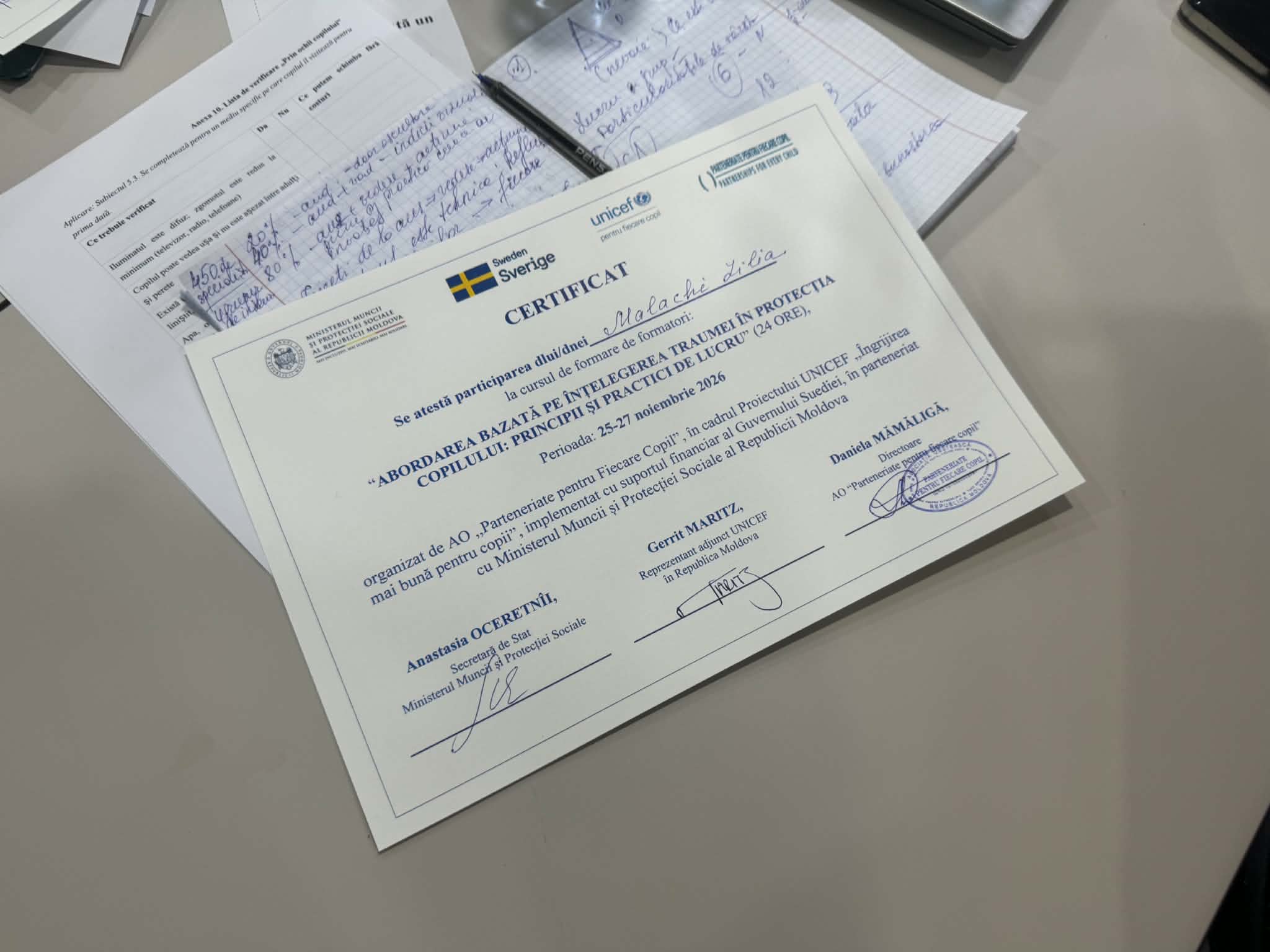
The Training of Trainers Programme, Trauma-Informed Child Protection: Foundation and Advanced Modules, concluded today after three days of training held in Chișinău. Organised under the auspices of the Ministry of Labour and Social Protection of the Republic of Moldova, with the support of UNICEF Moldova, the programme brought together practitioners and experts who will, in turn, train child protection professionals throughout the country.
Over the three-day programme, participants strengthened their training and facilitation skills, practised interactive learning methods, and explored ways to integrate trauma-informed principles into their professional practice. Particular emphasis was placed on understanding the underlying needs behind children’s behaviour and developing professional responses that foster safety, stability and trust.
“Children who have experienced adversity need professionals who understand their experiences and responses, not only their behaviour. Through this network of trainers, we aim to make trauma-informed practice an integral part of everyday child protection services and to ensure more effective support for children and families,” said Cristina Ursachi, Principal Consultant at the Ministry of Labour and Social Protection.
Viorica Dumbrăveanu, Child Protection Officer at UNICEF Moldova, highlighted the importance of the programme in the context of the ongoing development of the child protection system and the increasing complexity of the cases managed by professionals. She emphasised the essential role of trainers in strengthening the capacities of child protection professionals, noting that the programme goes beyond training itself by developing methodological resources that will be made available to practitioners. Ms Dumbrăveanu also reaffirmed UNICEF’s commitment to continuing capacity-building efforts for local professionals, including caregivers working across different types of services, and stressed the importance of drawing on the experience and perspectives of practitioners who work directly with children and families and understand the challenges they face on a daily basis.
The training programme consists of two modules—Foundation and Advanced—and is designed for managers and specialists from Territorial Social Assistance Structures (ATAS), community-level child protection specialists, and professionals working with children with complex needs, including those experiencing emotional and behavioural difficulties.
The event is organised by Partnerships for Every Child (P4EC) as part of the UNICEF project “Better Care for Children”, implemented with the financial support of the Government of Sweden, in close cooperation with the Ministry of Labour and Social Protection of the Republic of Moldova.