Access to Education for Displaced Children from Ukraine on the Authorities’ Agenda
22/05/2026
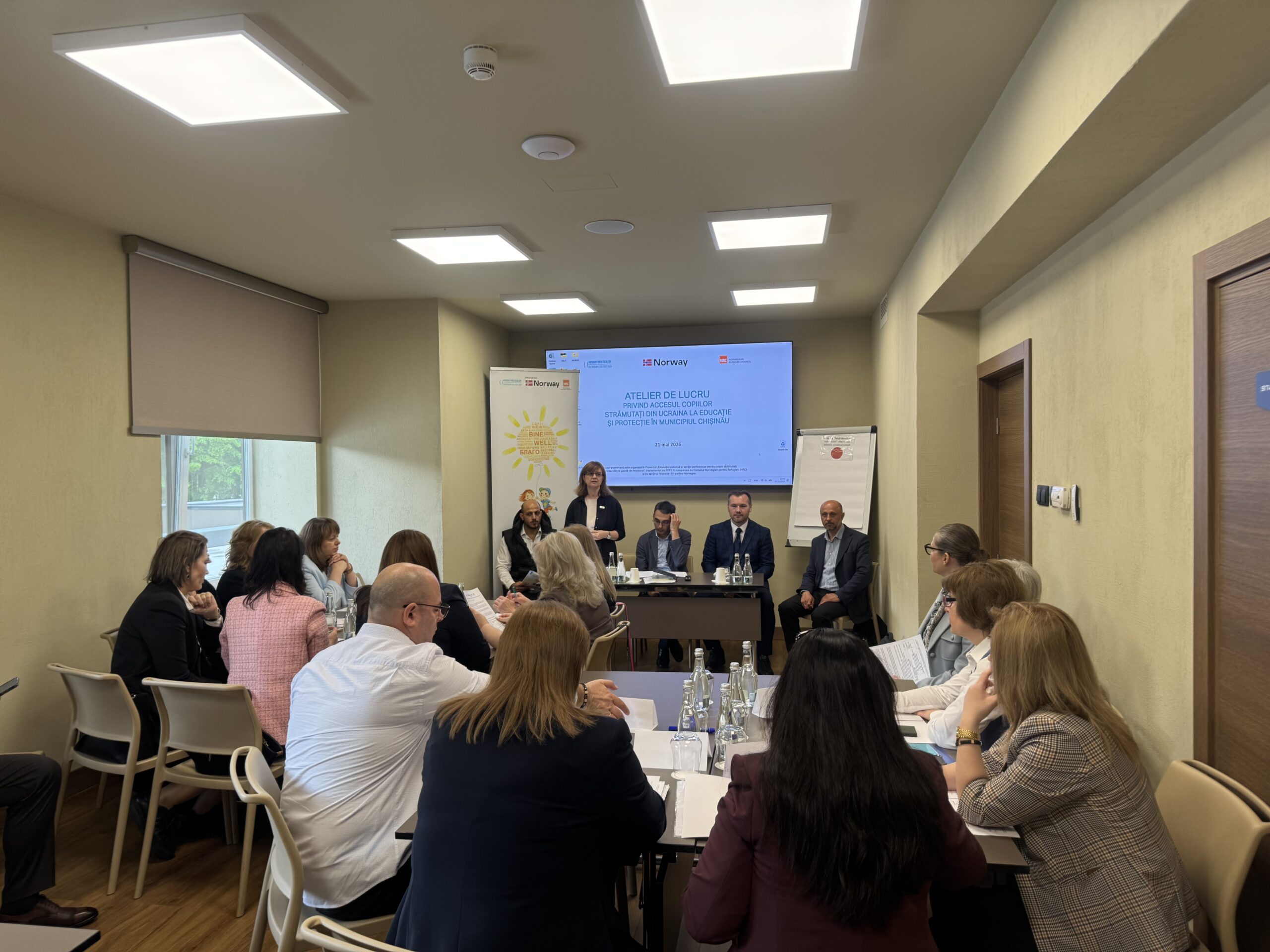
The importance of enrolling children displaced from Ukraine in educational institutions in the Republic of Moldova, particularly in the municipality of Chișinău, which hosts the largest number of refugee children, was discussed on Thursday, May 21, during a workshop dedicated to access to education and support services for this category of children.
The event aimed to create a common framework for intersectoral coordination regarding displaced children’s access to education and protection services in the municipality of Chișinău by identifying existing challenges, strengthening cooperation mechanisms, and establishing joint actions to support the educational and social integration of children and their families.
The event brought together representatives of the Ministry of Education and Research, the General Inspectorate for Migration, the Chișinău City Hall, including relevant municipal departments, as well as representatives of civil society organizations and partners involved in supporting displaced children from Ukraine. Their participation contributed to strengthening interinstitutional cooperation and identifying joint solutions for educational inclusion, psychosocial support, and the protection of refugee children.
Ivan Duminică, Head of the Interethnic Relations Policy Service within the Ministry of Education and Research (MER), spoke about the achievements and challenges faced by the Ministry in integrating refugee students from Ukraine into schools in the Republic of Moldova, including enrollment procedures, examination participation, and Romanian language learning.
“I reiterate the commitment of the Ministry of Education and Research to contribute, together with other responsible stakeholders, to the inclusion of refugee children in the educational system. It is important to encourage the transition from online learning to in-person education, as school provides children not only with education, but also with opportunities to socialize and integrate more easily into the community,” stated Ivan Duminică.
In turn, Victor Pruteanu, Deputy Mayor of the municipality of Chișinău, emphasized the importance of integrating all refugee children into the educational system, noting that the greatest pressure in this regard has fallen on the municipality of Chișinău. According to him, statistical data reveal a discrepancy between the number of school-age children present in the Republic of Moldova and those enrolled in educational institutions, suggesting that many of them are most likely continuing their studies online.
“We must support and encourage parents and children to choose in-person education. Direct participation in classes contributes to their social integration, especially in the municipality of Chișinău, where the greatest pressure in this process is being felt,” stated Victor Pruteanu.
According to Maher Daboul, Education Projects Manager at the Norwegian Refugee Council Moldova, cooperation among partners is essential for integrating refugee children into the educational system. He expressed gratitude to all organizations and institutions involved in supporting children and bringing them closer to schools.
“Collaboration and joint coordination are important pillars in creating a functional mechanism, and this workshop represents one of the platforms through which we can strengthen cooperation among all stakeholders involved, for the benefit and well-being of children,” stated Maher Daboul.
The workshop was organized within the framework of the project “Inclusive Education and Psychosocial Support for Displaced and Host Community Children in Moldova,” implemented by PPFC in cooperation with the Norwegian Refugee Council (NRC), with financial support from Norway and in coordination with the General Directorate for Education, Youth and Sports of the municipality of Chișinău.